“You inquire of me who were at the engagement at Grape Island. I may say with truth all of Weymouth, Braintree, Hingham, who were able to bear arms, and hundreds from other towns within twenty, thirty, and forty miles of Weymouth.” Abagail Adams in a letter to her husband John.
HINGHAM, MAY 19, 2024 - Sandwiched by a month between the more famous Battles of Lexington and Concord (April 19, 1775) and the Battle of Bunker Hill (June 17, 1775), was the Battle of Grape Island on May 21, 1775, in the waters just off today’s Hingham’s Crow Point and Weymouth’s Webb State Park.
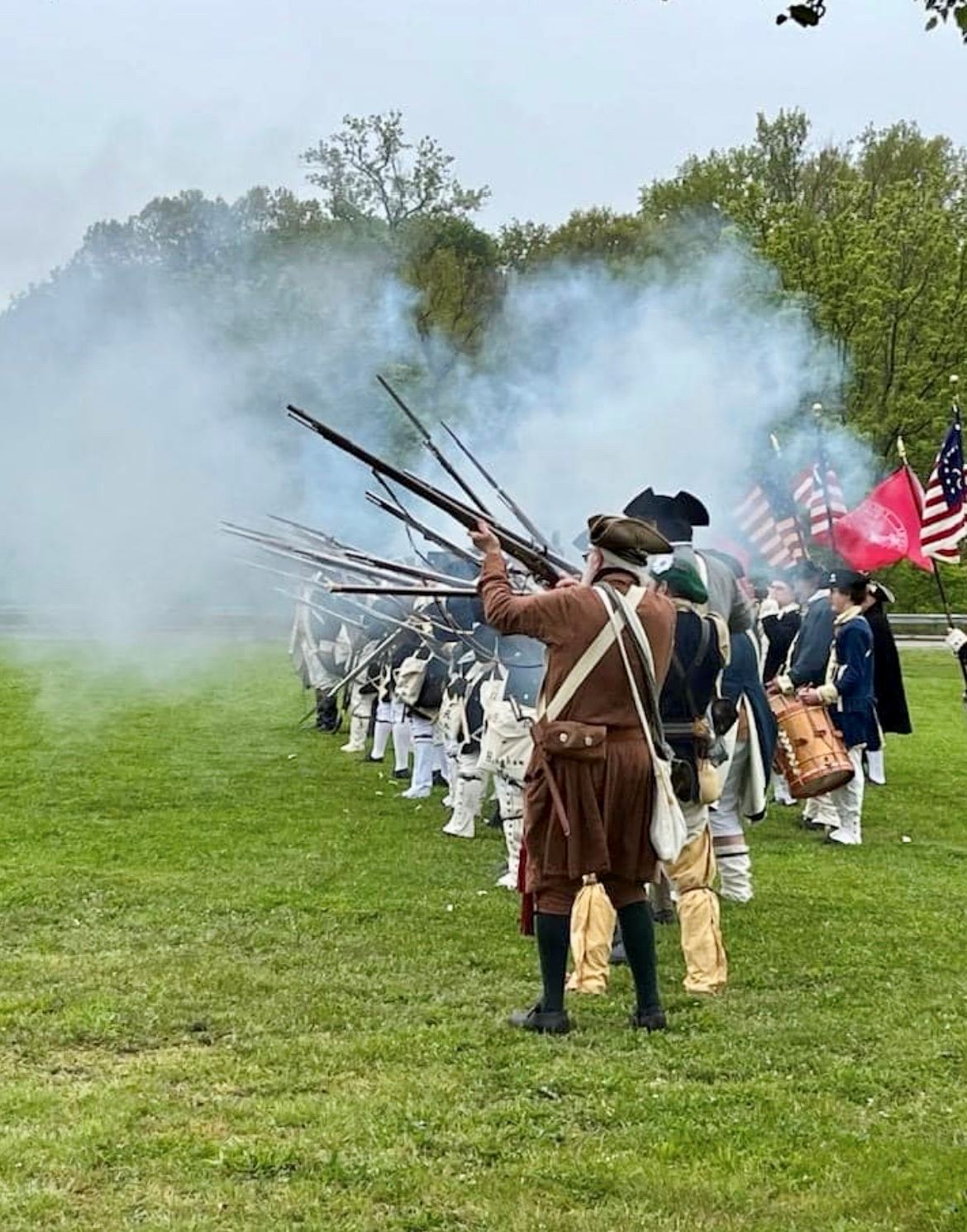
On Sunday, as part of the Revolution 250, a series of events to celebrate the 250th Anniversary of the American Revolution in Massachusetts, Hingham once again commemorated the Battle of Grape Island, with a reenactment of the skirmish that took place between British troops and local militia on Hingham loyalist Elijah Leavitt’s Grape Island, ceremonial remarks, historic narrative, music and refreshments at the Hingham Harbor Bandstand. A hearty group of over 100 came out in the damp weather for the event.
The reenactment was by the Hingham Militia, Wareham Militia and the 64th Light Infantry, and Ladies of the Green.
Grape Island, one of the several Boston Harbor Islands, was converted to farmland used by the early inhabitants of Hingham and Weymouth. At the time of the Revolutionary War, Elijah Leavitt, a Tory Loyalist, owned the island. As British forces searched for resources in the islands during the Siege of Boston, Leavitt gave British forces access to his hay. On May 21, 1775, in what became known as the Battle of Grape Island, the local militia of Hingham and Weymouth took boats to the island and fired upon the British and driving them away.
“By the start of the Revolution, Hingham was already 140 years old, and not to be trifled with! Between the Battle of Grape Island, Major General Benjamin Lincoln, and the other 73 veterans of the Revolution buried in Hingham Cemetery, contributed much to the cause. We are looking forward to being a part of ‘Rev 250’,” explained Andrea Young, the Town’s Historic Preservation Administrator.